
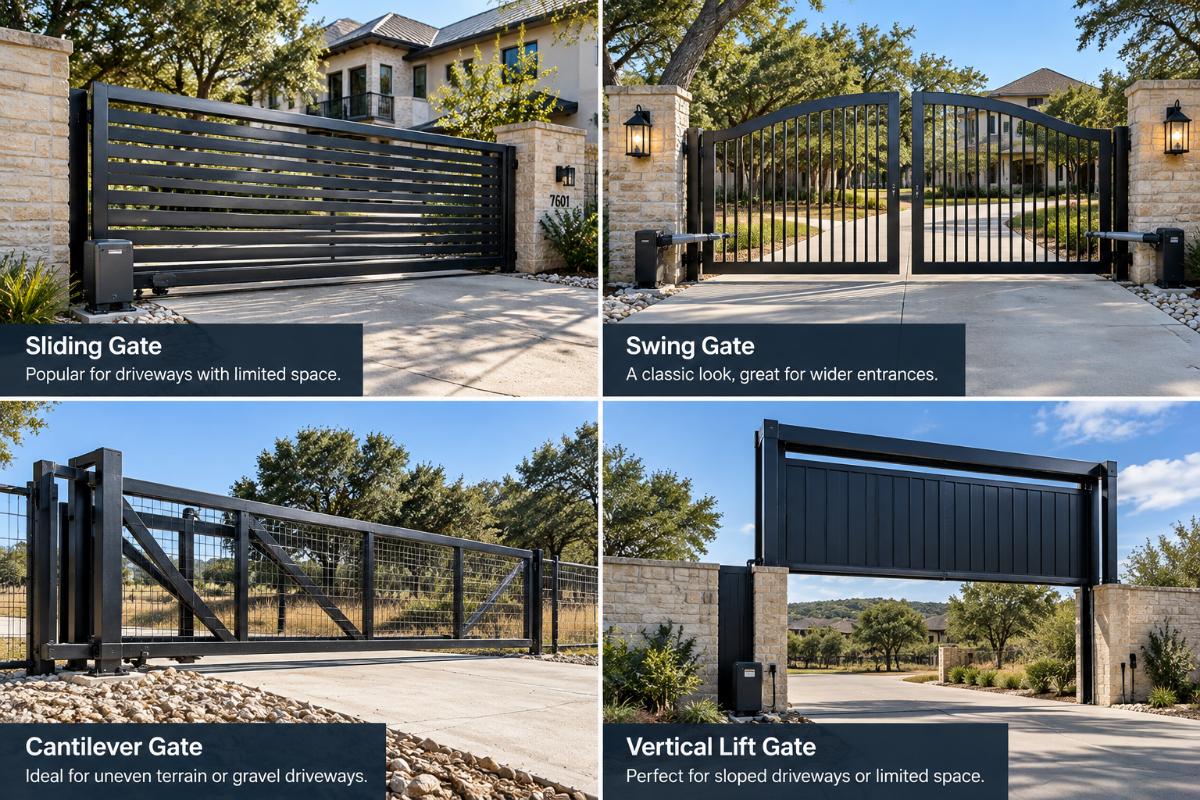
There are more types of driveway gates than any one property can take. Space, slope, and the room around the opening rule out most of them before anyone discusses design, so it’s worth knowing what each automatic gate asks for.
If you’d rather we looked at the entrance, describe your opening or call (512) 236-5178.
The two that cover most properties
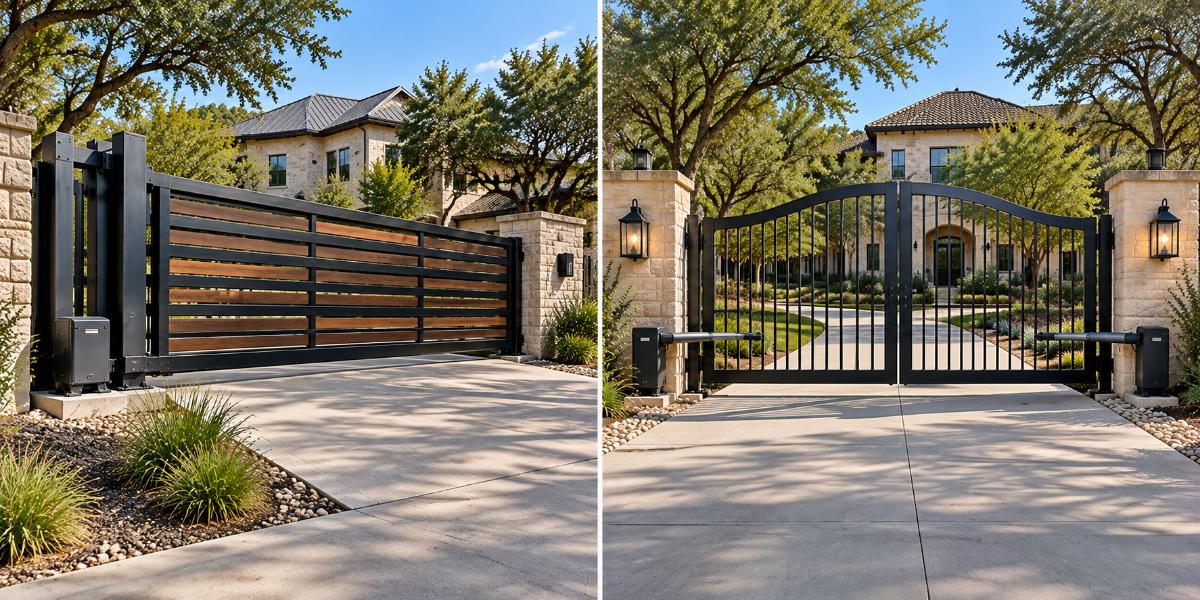
Nearly every residential gate we build is one of two things.
A swing gate pivots on hinges like a door. It’s the simplest arrangement; it’s usually the cheapest to automate, and it looks like what most people picture when they think of a gated entrance. It needs a clear arc for the panel to travel through and level or falling ground.
A slide gate rolls sideways across the opening. It needs no arc, which is why it suits short drives, rising approaches, and entrances close to a road. Instead, it needs clear run beside the opening, roughly the gate’s width.
Those two requirements almost never both exist on one property, and almost never both fail. That is why the comparison between them usually settles quickly once someone measures.
Single and double swing
A swing gate can be one panel or two.
A single leaf spanning the whole opening is simpler: one operator, one hinge post, fewer parts. The catch is the span. A twelve-foot panel acts as a long arm, and everything it does lands on one post and its footing.
A double swing, two leaves meeting in the middle, halves the span each one carries. Less load per post, a shorter arc per leaf, and usually a longer life. It costs a second operator and a second set of hardware.
On wider openings, the double gate is usually the better engineering, and what holds the panels up is where that difference shows up over the years in what holds the panels up.
Track and cantilever slides
Sliding gates split into two arrangements, and the difference matters more than it sounds.
A track slide runs on wheels along a rail set into the driveway. The ground carries the weight, which handles heavy panels well and costs less. The track collects grit and leaves, needs sweeping, and can bend over time from vehicles.
A cantilever slide carries nothing on the ground. The panel hangs from rollers on posts beside the opening, with a counterbalance tail extending past them. Nothing crosses the drive, so nothing to clean or ice over, which makes it the answer for sloped or poorly draining entrances. It costs more and needs more room.
How both arrangements work and covers the mechanics.
The less common types
These exist, and occasionally one is the right answer.
Bi-fold gates fold in half as they open, so each leaf needs only half the arc a full swing panel would. They suit entrances where there’s some room to swing but not enough, and they open faster than a single wide panel. More hinges and more hardware means more to maintain.
Vertical pivot gates lift the panel upward instead of swinging it sideways. They need almost no space on either side and handle uneven ground well, making them useful on tight industrial sites. They’re uncommon on houses, and they look it.
Barrier arms aren’t really gates. They control vehicles without securing the entrance, since anyone can walk past one. They suit parking control rather than property boundaries.
Vertical lift gates raise the whole panel straight up between towers. They’re a specialist industrial answer where neither side room nor arc room exists, and they’re rare on anything residential.
For most houses, the honest list is swing, double swing, track slide, and cantilever. The rest solve problems that houses don’t usually have.
What your property allows
Four measurements settle it, and you can take them yourself.
The clear opening, at its narrowest point, between posts or columns. The space beside the drive on each side, for a slide. What sits in the arc on each side, for a swing: a wall, a bank, planting, a parked car. Which way the ground goes as it leaves the opening, and roughly how much.
A drive that rises away from the road is the single most common reason a swing gate won’t work, because the panel drops toward the rising ground as it opens. Measuring the entrance covers those details.
Pedestrian gates alongside the drive
Many entrances need a way through on foot, and it’s easier to plan now than to add later.
A separate pedestrian gate beside the driveway gate keeps people out of the vehicle opening, which matters on a busy entrance and matters more where children use it. It can be manual while the main gate is automated, which most households find sensible, or it can take its own way of granting access so visitors on foot have a route in.
The alternative is making people walk through the driveway opening, which means the main gate cycles far more often than it needs to. On a gate rated for a household, that extra wear adds up over years; on an entrance serving many vehicles, it can be the difference between an operator lasting its service life and not.
What the gate is actually for
Worth asking plainly, because the answer changes the type.
If the point is privacy, infill matters more than configuration, and the structural consequences follow. If it’s security, what matters is that the gate closes reliably and that access can be withdrawn from one person without disrupting everybody else. If it’s keeping animals or children in, ground clearance and gap spacing matter more than either, and a wide gap underneath solves nothing.
If it’s appearance, say so. It’s a legitimate reason, and it changes the brief: material and detail become the priority, and the mechanical choices get made to support them rather than the other way round.
Most owners want some combination, and ranking them honestly at the start saves redesigning later.
Infill: the choice with structural consequences
Once you’ve settled on the type, you have to design the panel itself, and that is where cosmetic decisions turn into engineering ones.
Open picket lets wind through and weighs less. Lighter panels mean smaller operators, shallower footings, and less strain on everything over fifteen years.
Solid or privacy-backed panels screen the property from the road, which is often the point. They also catch a lot of wind, and every gust loads the panel, hardware, posts, and operator together.
Neither is wrong. The mistake is choosing solid infill for the look and specifying the rest of the gate as though it were picket. Choosing a residential design goes further.
Material and finish
Steel covers most residential work: strong for its weight, straightforward to fabricate, and repairable years later, which matters on something that moves thousands of times.
Ornamental ironwork suits properties where the entrance is part of the architecture, but it costs more and weighs more for the same span. Wood-clad gates put timber over a steel frame, which is the right arrangement, though the timber needs attention in Texas sun. Aluminum resists corrosion and weighs little, but it can flex across wide spans.
Powder coating over galvanized steel is the finish that lasts here. The coating holds color under sustained sun, and the galvanizing protects the metal even where the surface gets chipped.
How the type changes the automation
Each configuration requires a different machine, so it’s worth knowing before you fix a design.
Swing gates use an articulated arm or a linear actuator, and a double gate needs two of them coordinated. Slide gates use a rack-and-pinion or a chain drive running along the panel. What the machine does covers both.
What doesn’t change is the rule underneath all of it: the panel has to move freely before a motor is asked to move it. A gate that binds will consume operators, whatever type it is.
Where each type tends to fail
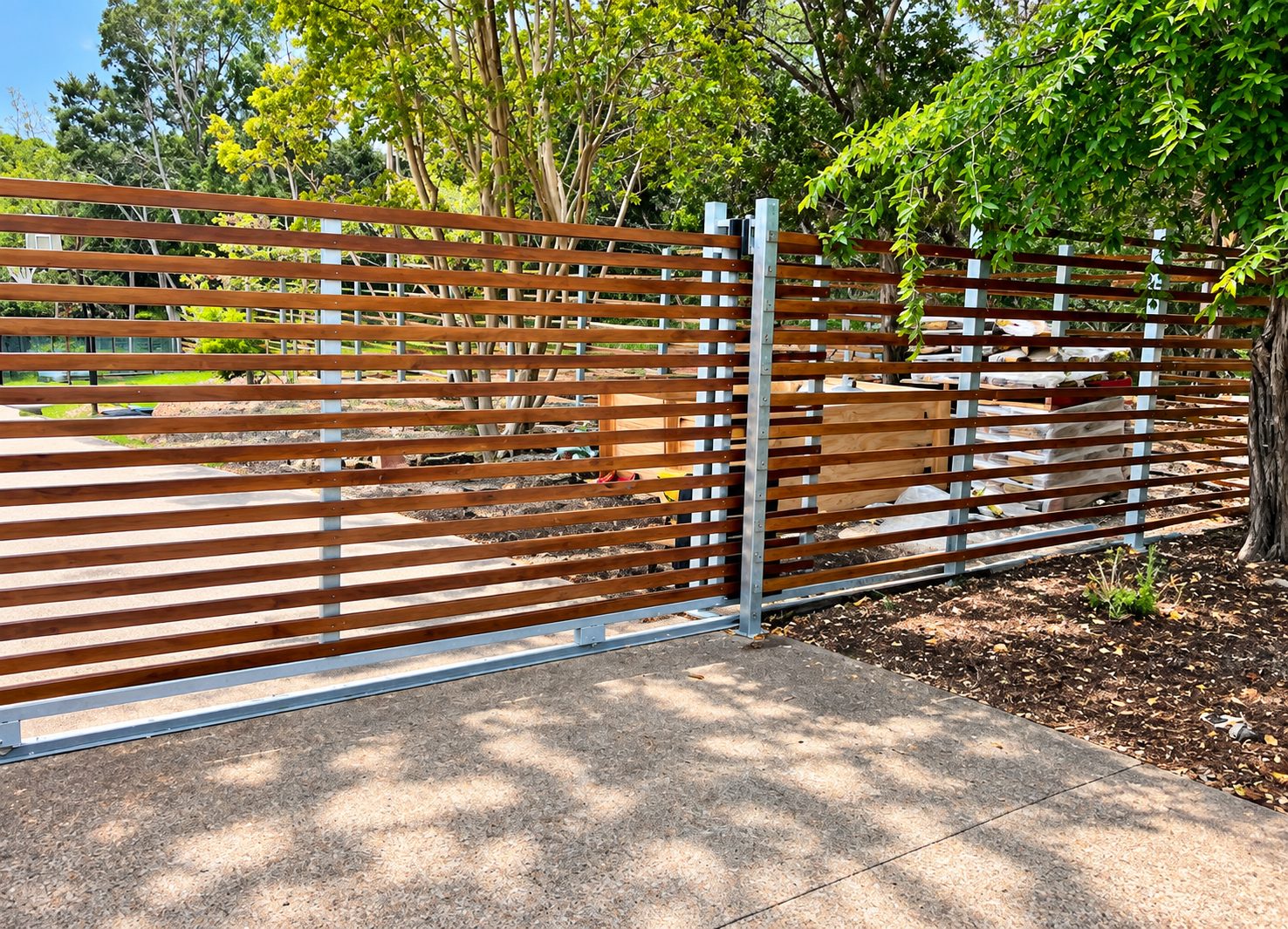
Knowing how a type wears tells you what you’re signing up for.
Swing gates concentrate everything on the hinge post, so when they go wrong, it usually shows as a sagging panel that no longer meets its catch. The fix is in the ground, not the hardware, which is why people so often misdiagnose it as an operator problem.
Track slides wear at the track and the rollers, which is more visible and more gradual. Debris is the usual culprit, and sweeping is the usual cure. Cantilever slides move wear to the roller assemblies and support posts instead, and those posts carry a lot, so they have to be right from the start.
Bi-folds have the most hardware of any residential type, which simply means more things to adjust over time. None of that makes one type unreliable. It just tells you where to look first when a gate starts behaving differently.
Narrowing it down
Start with what the property allows rather than what you’d like, because that list is usually short. Then choose infill, knowing it decides the weight. Then material and finish. Then the operator, sized to what you’ve designed.
Doing it in that order avoids the common outcome: a design everybody likes that the entrance can’t accommodate, or a panel specified heavier than the posts holding it up.
Ace Automated Gates | Austin builds all of these in our shop at 1821 Heatherglen Ln, Austin, TX 78758, sized to your opening rather than a standard width. We’ve been doing it since 2013. Fully insured, one-year craftsmanship warranty.
A new gate from scratch covers the build, and replacing one that’s reached the end covers the alternative.
There’s a range of finished entrances in the gallery if you want to see the types side by side. Call (512) 236-5178.