

Gate opener costs in Texas vary more than most people expect, and so does the gate itself. Two quotes for the same entrance can differ by thousands, and there is almost always a reason hiding in the parts nobody photographs.
This page explains which of those apply to a given property. If you’d rather skip to a figure for yours, tell us about the entrance or call (512) 236-5178.
Why quotes vary so much

Two gates that look identical from the street can be very different jobs.
Location plays into it too: Hill Country work around Bee Cave often means rock excavation, while replacements around Buda more often turn on what can be reused. Span and panel weight come first. A wider opening needs a heavier frame, and a heavier frame needs a larger operator, deeper footings, and stronger hardware. Those costs compound rather than add, which is why a gate two feet wider is rarely two feet more expensive.
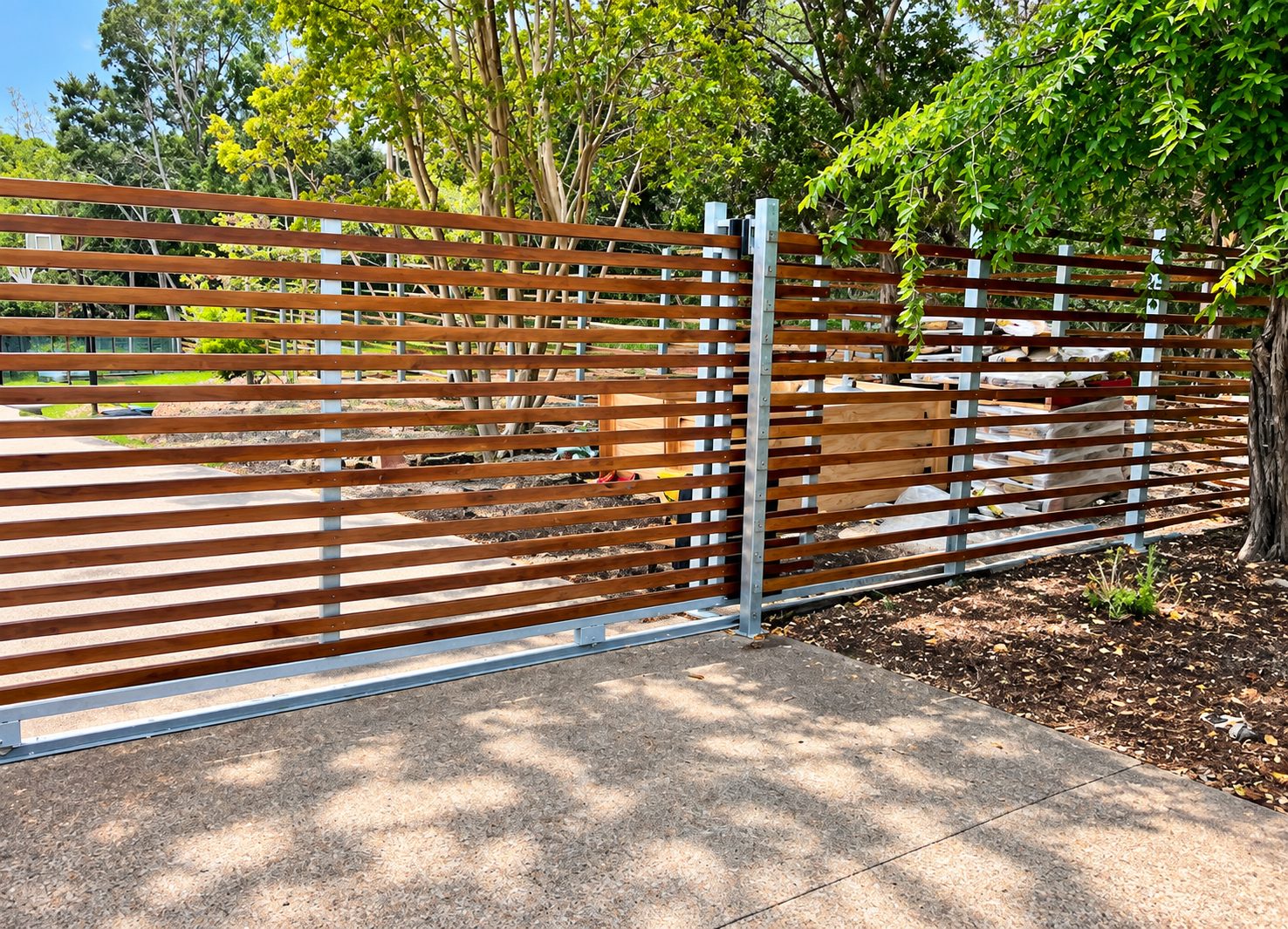
Material follows. A solid privacy-backed panel weighs considerably more than open picket work of the same span, and it catches far more wind, which pushes the whole specification up again. That’s a structural decision wearing the clothes of an aesthetic one.
Then configuration. Swing systems are generally cheaper to automate than slide systems, but only where the drive has room for a panel to arc into. Where it doesn’t, the comparison stops being about cost. Comparing swing against slide covers when each one is actually available to you.
What the ground costs
This is the single most underestimated line in any gate quote, and it varies enormously across the metro.
There’s no standard post depth. Gate size and weight, swing or slide, post size, soil conditions, wind exposure, and the equipment being installed all decide the foundation. A driveway gate loads a post very differently from a pedestrian gate, and on a large swing panel the posts carry both the weight and the forces of every start, stop, and reversal.
West of the city, you hit limestone and caliche. That ground doesn’t move, which is good, but excavating it is slow and expensive. East of the interstate, the soil is expansive and moves seasonally, so the foundation is designed to resist that movement rather than just the load. Neither is cheap. They’re expensive for opposite reasons.
Cutting the foundation is the most common way a quote comes in low, and it’s why we get called back to gates that start sagging a few summers later.
Power, and why solar isn’t automatically cheaper
If mains power is close to the entrance, running it is usually straightforward. If it isn’t, you’re either trenching a long distance, sometimes through rock, or you’re going solar.
Solar looks cheaper on the quote and often is, particularly on long approaches where trenching would be substantial. But it isn’t consequence-free: the system has to be sized to how the gate is actually used, and optimistically sized solar systems start failing when the gate cycles more than the design assumed. Under-specifying here costs more than it saves.
Duty cycle, which most people never think about
How often the gate opens changes which operator you need, and operator class is a real cost step rather than a gradual slope.
A household gate cycling a handful of times a day and an apartment entrance cycling sixty times are different machines. which operator class a gate needs explains the bands. Fitting a residential unit to a commercial entrance saves money once but costs more in the long run, which is why entrances with heavy traffic are quoted differently from the outset.
Where you can reasonably spend less
Some savings are real, and some are borrowed from your future self.
Real ones: simpler panel design, open picket instead of solid infill where privacy isn’t the point, a standard configuration rather than custom ironwork, and reusing sound posts and conduit if you’re replacing an existing gate rather than starting fresh.
Entry hardware can also start simple and expand later, provided the conduit is sized for it now; on a home that often means a keypad at the outset, with card or app access added once the household knows what it needs, which is a genuine saving rather than a deferred cost. The same logic applies to a gate at a private house, where the temptation is to specify for a household that hasn’t moved in yet.
Borrowed ones: shallow footings, an undersized operator, skipping safety sensing, and cheap access hardware in a location that gets weather. Each of those shows up again within a few years, usually with a callout attached.
Why we don’t publish a price list
Because it would be misleading in a way that isn’t useful to you.
The same gate on two properties a mile apart can differ by a large margin on foundation and power alone, and any number we printed would either be so wide as to be meaningless or so narrow as to be wrong for most people. We’d rather look at the opening and give you a figure that holds.
What we can tell you before we visit is which of the factors above apply to your property, which usually narrows the range considerably. Call (512) 236-5178, and we‘ll outline the full range of work.
Ace Automated Gates | Austin, 1821 Heatherglen Ln, Austin, TX 78758. We’ve been building gates here since 2013; we’re fully insured, and everything carries a one-year craftsmanship warranty. There’s finished work in the gallery if you want a sense of what the money buys.