
Table of Contents
ToggleEvery Gate Service We Offer, and What Each One Covers
Our automated gate services cover three things: building gates, making them move, and fixing them when they stop. This page explains what each includes, so you can figure out what you need before anyone quotes you.
Not sure which one applies to you? Tell us about your gate, and we’ll point you to the right one, or call (512) 236-5178. If the existing gate is past saving, starting over is its own decision with its own economics.
Submit this form to request quote
What we install
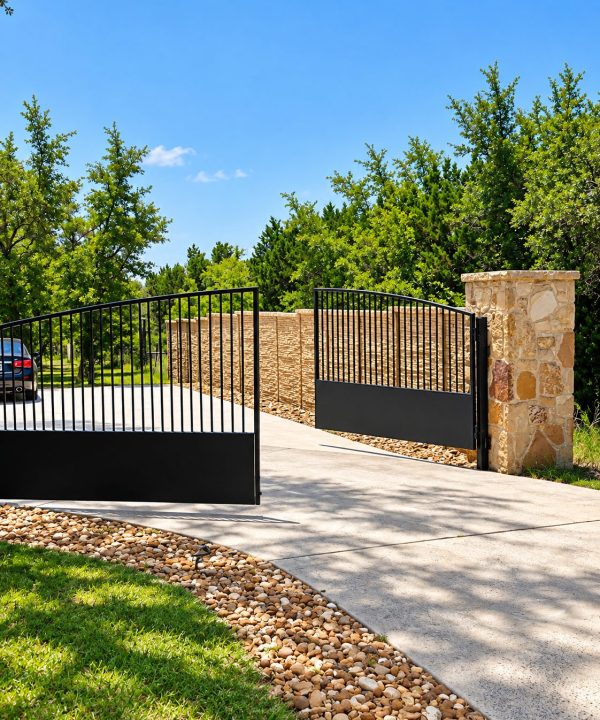
Most new work starts with an opening and no gate, or a gate that’s past saving. Installing a gate from scratch covers the full sequence: measuring the opening, fabricating the panel in steel or iron, setting the hinge posts, trenching the conduit, and mounting the operators themselves. We weld in our own shop, so we size the panel to your drive rather than ordering to the nearest standard width.
Where a property has no practical power run to the road, solar-powered operators do the same job off a panel and a battery. That’s most of the acreage work west of town. It’s got to be sized properly against panel output, battery capacity, and how many cycles a day the gate genuinely sees, because undersized solar is one of the most common things we get called out to fix on somebody else’s install.
If a manual gate is already there and structurally sound, automating what you have is usually cheaper than replacing it. The decision comes down to the posts and the panel, since automation puts loads on a gate that hand-opening never did, and posts that were fine for twenty years of pushing by hand aren’t always fine for this. Gate configurations that work well for an operator aren’t always the ones that look best standing still, and that’s worth knowing before you’ve committed to a design.
What we repair and service
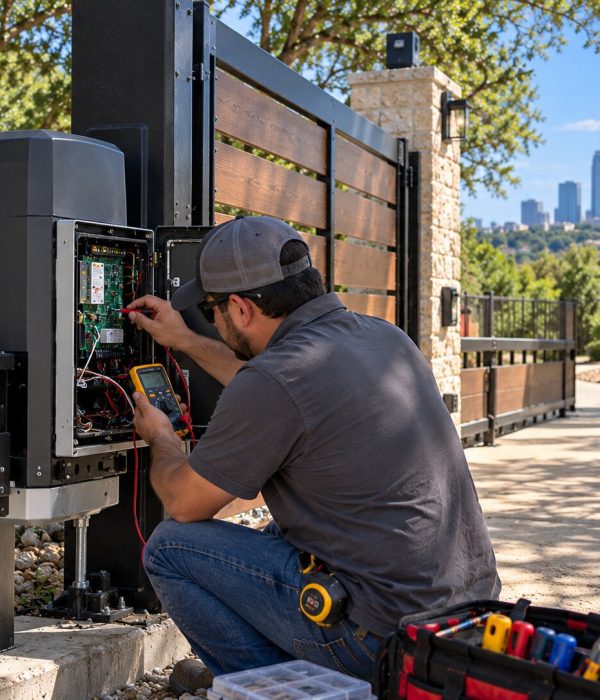
Gate repair makes up a good share of the calendar, and most of it is somebody else’s installation. Gates fail in a few ways: something binds mechanically, a limit switch drifts out of position, the power dies, or a safety device holds the gate open, and nobody knows why. We diagnose on site, carry the parts that fail most often on properties around here, and finish a fair number of repairs on the first visit.
We service whichever operator brand is already on the property. There’s no line we’re contracted to move, so when we say a unit’s worth repairing or isn’t, that’s the assessment rather than a sales position. Scheduled servicing costs less than the emergency call it prevents, which matters most on commercial entrances cycling dozens of times a day.
How people get through the gate
Access control is the last thing owners think about, and they use it every day. A household usually wants a keypad and a couple of remotes. A shared drive needs something that handles several families without everyone passing round one code. An apartment entrance needs a resident directory, individual credentials, and a way to cancel one when somebody moves out.
The hardware runs from keypads and card readers through telephone entry, camera intercoms, and phone-based access, plus the loop detectors and exit sensors that let a vehicle out without anyone touching anything. Most failures come down to wiring and water, not the devices themselves, and they don’t announce themselves until the gate’s already stopped, which is why we trench the first time properly.
Who each service suits
Gates on suburban drives make up most residential work: standard openings, an HOA with a view about how the gate matches the run of the property line, and an entry method everyone in the house can manage without being taught twice. Commercial entrances are a different spec entirely, built around how many people need through and how long a failure leaves the property standing open.
Acreage sits between the two and behaves like neither, and the configurations available narrow quickly once slope enters the picture. Long approaches, real slope, cattle guards, and power a long way from the road, which is why so much of that work ends up on solar and why the panel itself is usually wider and heavier than anything a subdivision needs. Wider panels need heavier operators, deeper footings, and more thought about what the gate does in a crosswind, so specs climb quickly once you get past a certain opening width.
How a job runs
Every job starts with the opening, because width, slope, and turning room matter more than preference. What you’d like and what’ll work aren’t always the same thing. From there, we quote the gate and automation as one job instead of two, which is the whole point of doing both under one roof. You get one crew, one schedule, and one number to call when something needs attention.
The work carries a one-year craftsmanship warranty. We’ve been doing this since 2013; we’re fully insured, and when a job needs a new circuit or panel work, we bring in a licensed electrician rather than improvising. If you want a sense of the numbers first, there’s a cost guide, and past installs will show you more about the finish standard than any description here will.
Ace Automated Gates | Austin works out of 1821 Heatherglen Ln, Austin, TX 78758, and covers the metro area and surrounding cities. Call (512) 236-5178 and tell us what the opening looks like.
Frequently Asked Questions
Which service do I need if my gate still opens but badly?
Probably repair rather than replacement. A gate that opens slowly, stops short, or judders usually tells you something mechanical has shifted, not that the machine itself has failed. We diagnose before quoting, since on an established gate the cheaper answer is often the right one, more often than people expect.
Do you quote the gate and the automation separately?
No, we quote them as one job. Splitting them leaves properties with a panel the operator cannot handle, and it leaves two companies blaming each other when it fails. You still see what each part costs, but responsibility for the finished system sits in exactly one place.
What is involved in a servicing visit?
We cycle the gate and watch how it moves, then work the mechanical side first: hinges, posts, track, rollers, and chain tension. After that, we check the operator, its power supply, and the entry devices. We flag anything nearing failure; addressing it while it is still cheap is better than waiting until it’s urgent.
Can you take on a property with several gates?
Yes, and mixed hardware across a single site is common when different contractors installed pieces of it over time. We hold no exclusive brand line, so we service whatever is already there rather than pushing standardization across commercial entrances that you have no particular reason to pay for right now.
How far ahead do I need to book?
We prioritize emergency work, particularly a gate left standing open on an occupied property. Planned installations depend on fabrication time and whether footings need to cure, so they often span more than one visit. Tell us which of the two you are dealing with when you call, and we will schedule accordingly.
Do you handle the electrical side?
We wire the operator, the safety devices, and the entry hardware as part of the installation. If a job needs a new circuit or work at the consumer panel, we bring in a licensed electrician rather than improvising, and we say so upfront when a job is heading that way.