
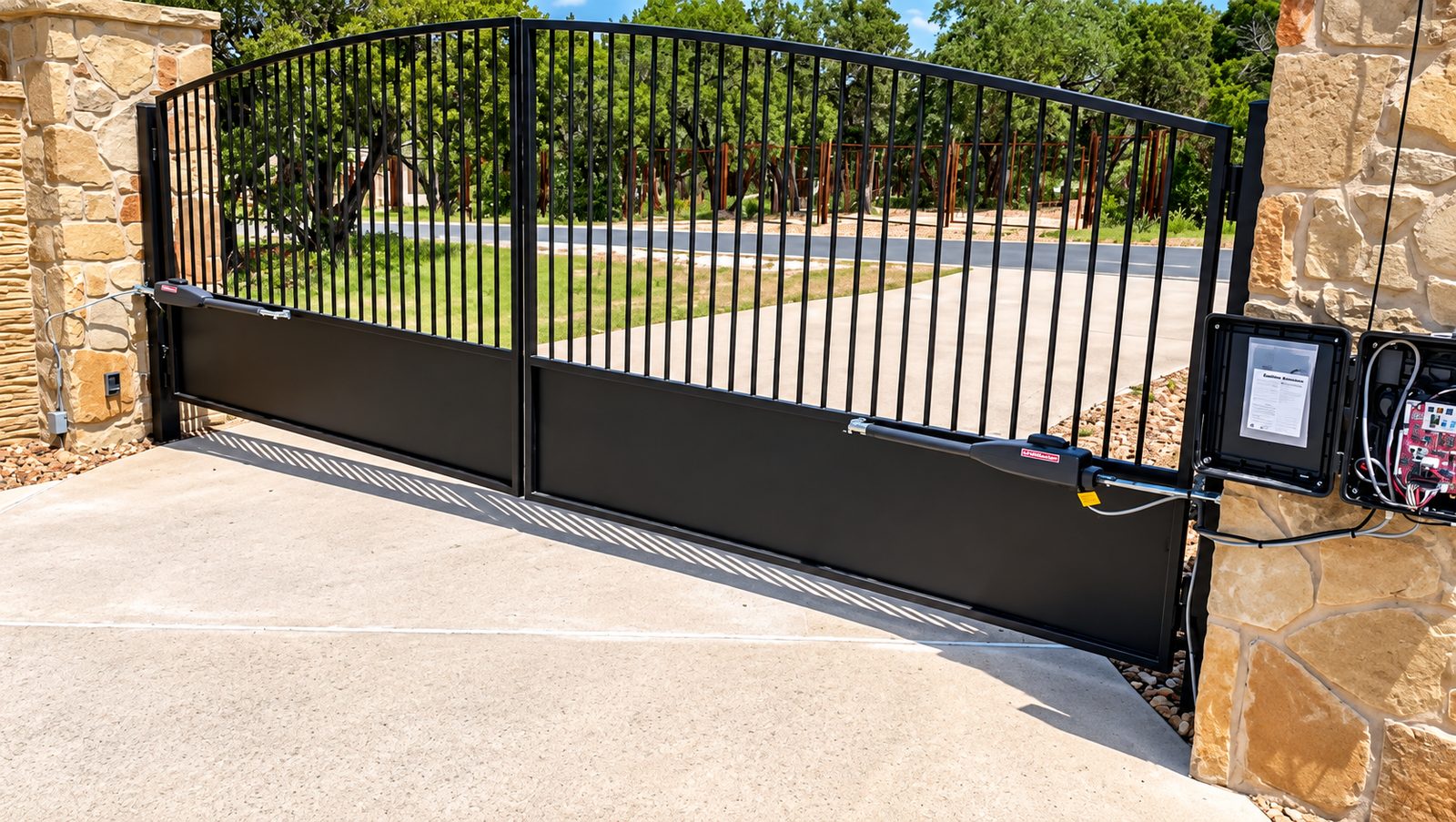
How wide should a driveway gate be? Twelve feet suits most single driveways, and an automatic gate much under ten feet starts to feel tight. But width alone doesn’t decide what you can build. The ground leading up to the gate matters just as much.
If you’d rather we measured it, send us the opening or call (512) 236-5178.
Starting with width
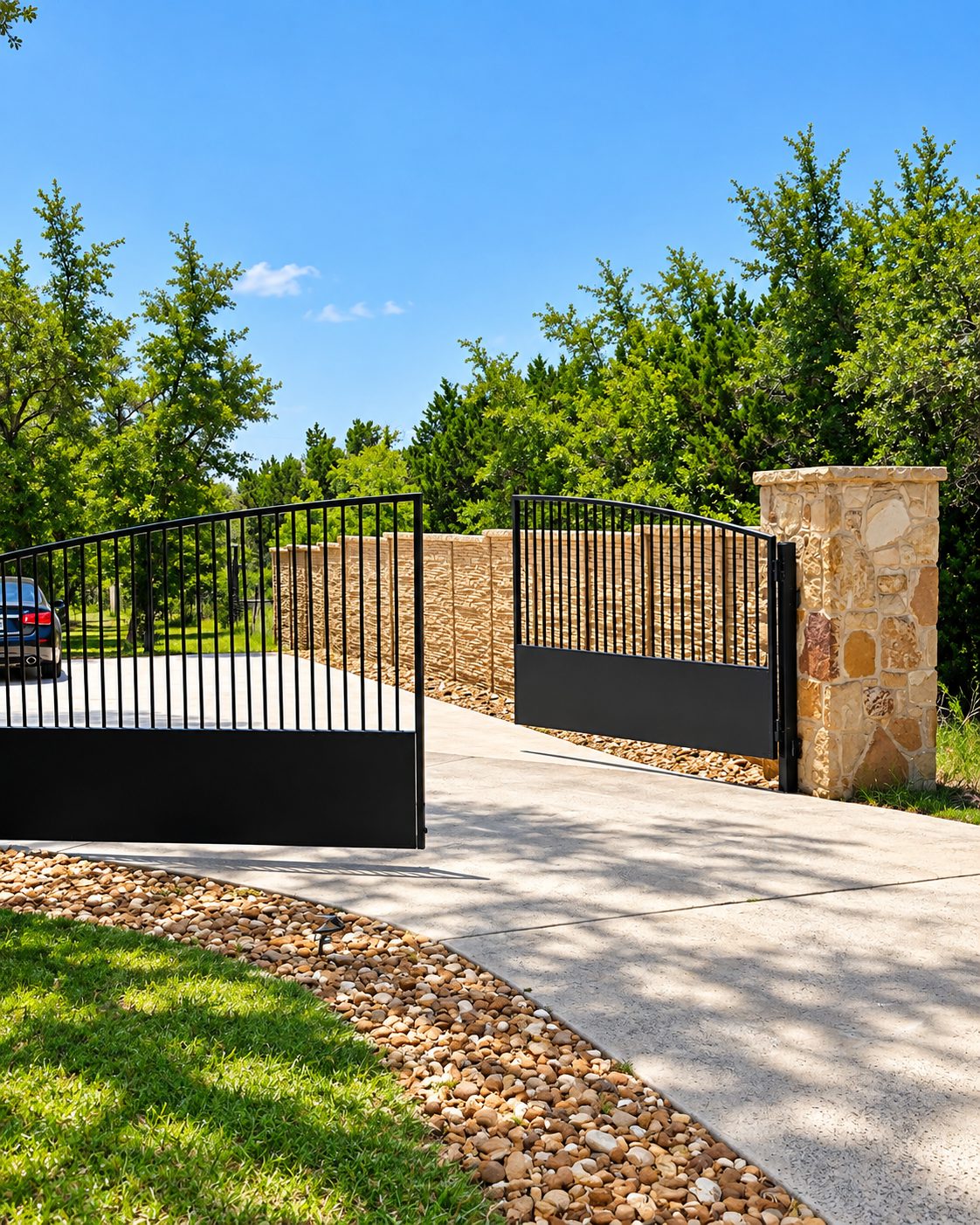
For a standard residential driveway, twelve feet of clear opening is the usual answer, and it’s clear opening that counts, not the distance between the outer faces of the posts.
Ten feet works, but it leaves little room for error, particularly for anyone towing or driving something wide. Fourteen to sixteen feet is common where two vehicles pass, where deliveries come through regularly, or where the drive curves near the entrance so vehicles arrive at an angle.
Commercial and multifamily entrances usually run wider again, because the vehicles are larger and the traffic is constant. Those entrances get sized around what actually uses them rather than a standard figure.
The mistake worth avoiding is measuring for the car you drive now. Gates last fifteen years or more. Trucks, trailers, and delivery vans all have to fit for that whole period.
What the approach decides
This is the part people don’t expect, and it often matters more than the width.
Room behind the hinge. A swing gate sweeps through an arc, and that arc has to land somewhere. If there’s a wall, a slope, or planting where the panel would travel, a swing gate can’t open fully no matter how wide the opening is.
Room to the side. A slide gate needs roughly its own width to slide into alongside the opening, and the two systems set out where each one fits. Where that space doesn’t exist, a cantilever system can work, but it needs even more room beside the drive.
Slope. A drive that rises away from the road is one of the most common reasons a swing gate won’t work. As the panel swings open, it drops toward the rising ground and catches. Sometimes the fix is to hang the gate to swing outward, which brings its own problems when a vehicle waits on the road.
Where vehicles stop. There needs to be somewhere to wait clear of traffic while the gate opens. On a short drive off a busy road, that single factor sometimes decides everything else.
Which gate configuration suits a property comes down to these four things far more often than to preference.
Single or double
A single panel spanning twelve feet is a long lever. It puts real load on one hinge post, and that post has to be built for it.
Two panels meeting in the middle halve the span each one carries, which usually means less strain and a shorter arc for each leaf. The trade is a second operator and a second set of hardware. On wider openings, the double gate is normally the better engineering answer, and on narrower ones a single panel is simpler.
Slide gates avoid the arc problem entirely, which is why they suit short drives, rising approaches, and entrances close to the road. They ask for side room instead.
The measurements worth taking

You can gather all of this with a tape measure before anyone visits.
Measure the clear opening between the posts or columns, at the narrowest point. Measure the distance from the gate line back to the road, which tells us where a vehicle can wait. Measure the space beside the drive on each side, for a slide gate. Note whether the ground rises, falls, or sits level as it leaves the opening, and roughly by how much over the first few feet.
Then note what’s within the arc on each side: walls, planting, a slope, a parked car that always sits there. That’s usually the detail that settles swing against slide.
Send those along with a photo from the road and one from inside the property, and we can usually tell you what will and won’t work before we arrive. Getting a new gate built depends on what happens next.
Why it changes the cost
Width and approach both drive the price, and not gently.
A wider gate is heavier, which means a larger operator, deeper footings, and stronger hardware, and those step up in bands rather than smoothly. What moves a gate quote covers the rest of the variables.
The approach affects it differently. A slide gate on a site with no side room means a cantilever system, which costs more. A rising drive might mean regrading. The panel carrying the load also needs posts built to carry it, and on a wide single gate that’s a significant part of the job.
Getting it right the first time
The width you choose and the space you have are usually settled in an afternoon, and they shape everything that follows.
For most homes, that means twelve feet of clear opening, a double-swing gate where the arc has room, and a slide system where it doesn’t. Choosing a home gate design covers the design decisions that sit on top of that.
Ace Automated Gates | Austin works out of 1821 Heatherglen Ln, Austin, TX 78758. We’ve been building gates here since 2013; we’re fully insured, and the work carries a one-year craftsmanship warranty. There are gates at a range of widths in the gallery if you want a sense of how different widths look installed. Call (512) 236-5178 with your measurements.