
Table of Contents
ToggleCommercial and Multifamily Gates, Specified for the Traffic They Take
Commercial automatic gates are different from residential ones, and the difference isn’t size. It is cycle count. A gate opening sixty times a day does ten times the work, and every component has to be specified for that.
If you know roughly how many vehicles pass through daily, tell us your traffic volume or call (512) 236-5178, and the cost drivers will explain why the number moves so much.
Submit this form to request quote
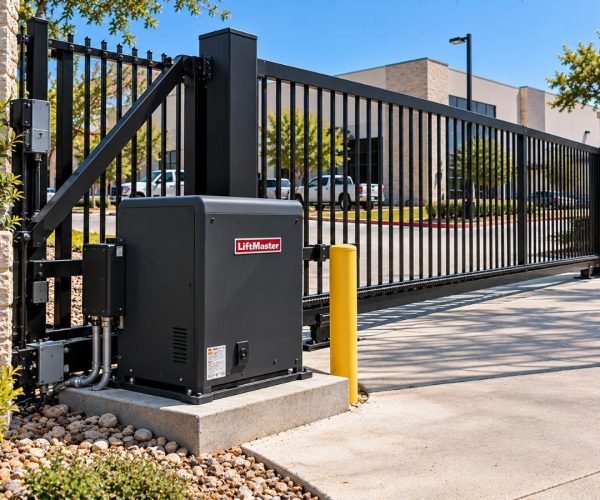
Cycle count decides the specification
Duty cycle is the number that drives everything else. Panels, hinges or rollers, chain, and above all the operator wear at a rate set by how often the gate moves, not by how heavy it is.
That’s why high duty cycle operators exist as a separate class, and why fitting a residential unit to a busy apartment entrance guarantees a callout within a year or two. Hydraulic units earn their added complexity here in a way they rarely do on domestic driveways.
Configuration follows the site. Where there isn’t room for a panel to arc, or where the approach runs tight to a building, cantilever slide systems carry the span without a track across the drive. Cantilever slide systems work differently from rolling gates and are specified differently too, and the available panel configurations all behave differently under constant use.
What a failure actually costs
On a house, a failed gate is an inconvenience. On a commercial property, it’s an entrance standing open, or a tenant who can’t get to work.
That changes what’s worth specifying. Redundancy in the entry hardware, battery backup sized to real cycle counts rather than a nominal figure, and a manual release that staff has actually been shown how to use. It also changes response expectations, which is why emergency response matters more here than the last few percent of hardware quality.
The failure pattern is the same one we see everywhere, just accelerated. A hinge post shifts or a track goes out of level, the operator works harder on every cycle, and at sixty cycles a day it reaches the end of that road far faster than a home gate would, which is the argument for planned servicing rather than waiting for the call.
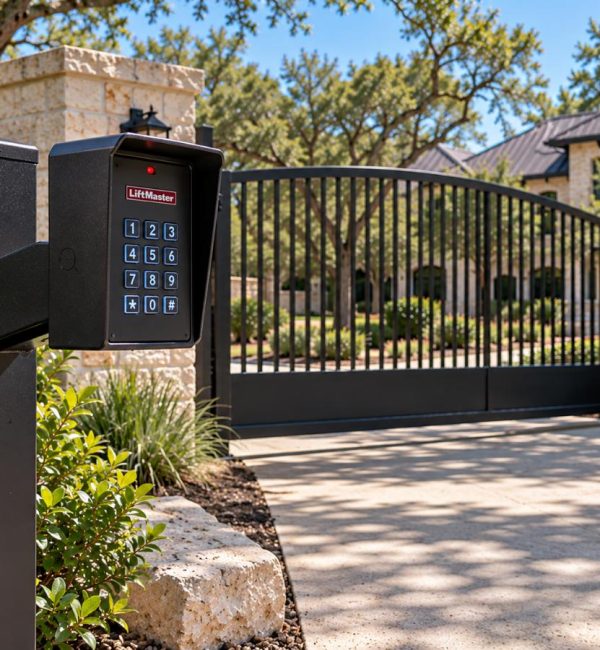
Who needs to get through
Residents, staff, visitors, deliveries, contractors, and emergency services are six different access problems, and most commercial entrances have to solve all of them.
That means individual credentials rather than a shared code, a way to revoke one cleanly when somebody leaves, and usually an administrator who can manage the list without standing at the gate. Multi-user credential systems include card readers, fobs, cloud-managed access, and resident directories, and the right choice depends more on how often your user list changes than on how many names it has.
Emergency access needs to be settled explicitly, not assumed. So does what happens to deliveries at seven in the morning, and where a vehicle waits while the gate opens without backing traffic into the road. On a tight site, that last question sometimes changes the gate configuration entirely, because a swing panel that needs clear arc space can push the waiting vehicle somewhere it can’t safely sit.
How it gets specified
We design the gate, posts, operator, access control, safety devices, and power source as one system. On commercial work, that matters more than anywhere else, because the alternative is what we usually find: electrical, controls, safety devices, and power all added as separate pieces by different hands at different times.
Each piece works. The assembly doesn’t, because nobody owned the question of how they’d behave together at volume. Designing the entrance as one job is the fix, and it’s considerably cheaper than retrofitting around somebody else’s decisions.
Site conditions constrain more than people expect. Rock, slope, drainage, existing concrete, and underground utilities all determine where cable and conduit can physically run, which is why we position credential hardware on site during design rather than afterward, and why a design drawn without knowing what’s under the drive gets compromised during the install rather than before.
Everything carries a one-year craftsmanship warranty, and we’re fully insured. When a job needs a new circuit or panel work, we bring in a licensed electrician rather than improvising.
No exclusive line
We hold no dealership with any operator or manufacturer, on commercial work that matters practically rather than philosophically.
It means we specify against your cycle count instead of against what we’re contracted to move, and it means we’ll service whatever is already on the property when you inherit a system somebody else installed. On a portfolio of buildings with mixed hardware, that’s usually more useful than a single-brand relationship, and it’s why our repair work spans so many operator lines.
It also means a recommendation to replace an operator is a recommendation, not a sale. When a unit is fine, and something upstream of it is causing the failures, we’d rather say so and fix the actual problem, even where the larger job would have been easier to sell.
Where we work
Ace Automated Gates | Austin fits commercial and multifamily gates from 1821 Heatherglen Ln, Austin, TX 78758, across the metro and surrounding cities, including gated communities where entrance requirements are decided before anything is built.
Ground conditions reach commercial work too. Western Austin brings limestone and caliche. Areas with expansive clay move, and movement eventually puts an operator under a load it was never specified for.
You can see commercial sites we’ve completed in the gallery, and the wider service list covers everything else. Call (512) 236-5178 with your daily vehicle count, and we can size the system quickly.
Frequently Asked Questions
What makes a commercial gate different from a residential one?
Cycle count, mostly. A busy entrance opens dozens of times every day, which wears operators, chain, rollers, and hinges at a rate a household gate never approaches. The specification follows that number rather than the width of the opening, and fitting a residential-class unit to a busy site guarantees a callout within a year or two.
How many credentials can you manage on one site?
Hundreds, with card or cloud-managed systems that record which credential was used and let you revoke one cleanly. The right system follows how often your user list changes, not just how long it is. A site with high turnover needs different hardware from one with the same fifty tenants for a decade.
What happens if the gate fails outside business hours?
That is worth specifying deliberately rather than discovering. Battery backup covers a set number of cycles, a manual release lets staff open the entrance by hand, and both should be demonstrated to whoever is actually on site rather than documented in a folder nobody opens until the evening it matters.
Can you take on gates another contractor installed?
Yes, and on commercial portfolios, that is most of what we are asked to do. We hold no exclusive brand line, so we service mixed hardware across a set of buildings without pushing a standardization you have no reason to fund. Mixed sites are the normal case rather than the exception.
Is scheduled maintenance worth paying for?
At commercial cycle counts, comfortably. Wear becomes predictable when a gate moves constantly, making planned servicing far more effective than on a household gate that opens twice a day. The cost of a maintenance visit sits well below the cost of an entrance standing open for a day during business hours.
How is emergency services access handled?
It needs to be settled explicitly during design, not assumed afterward. How fire and emergency access works at your entrance affects the hardware chosen, where it is placed, and sometimes the gate configuration itself. Retrofitting that requirement onto a finished installation is considerably more expensive than allowing for it from the start.
What sets the timeline on a commercial job?
Groundwork and coordination rather than fabrication. Foundations have to cure, conduit runs are usually longer than on a house, and the access hardware needs commissioning and testing before the entrance goes live. On an occupied site, we also have to plan how vehicles get in while the work is ongoing.