

Automatic gate opener troubleshooting starts with one idea: a gate has to work properly before you ask a motor to move it. Most what people report as an operator fault turns out to be the gate itself.
That one distinction explains most of our repair calls, and it’s worth understanding before you spend anything. If your gate has already stopped, get someone out or call (512) 236-5178.
The failure almost nobody sees coming
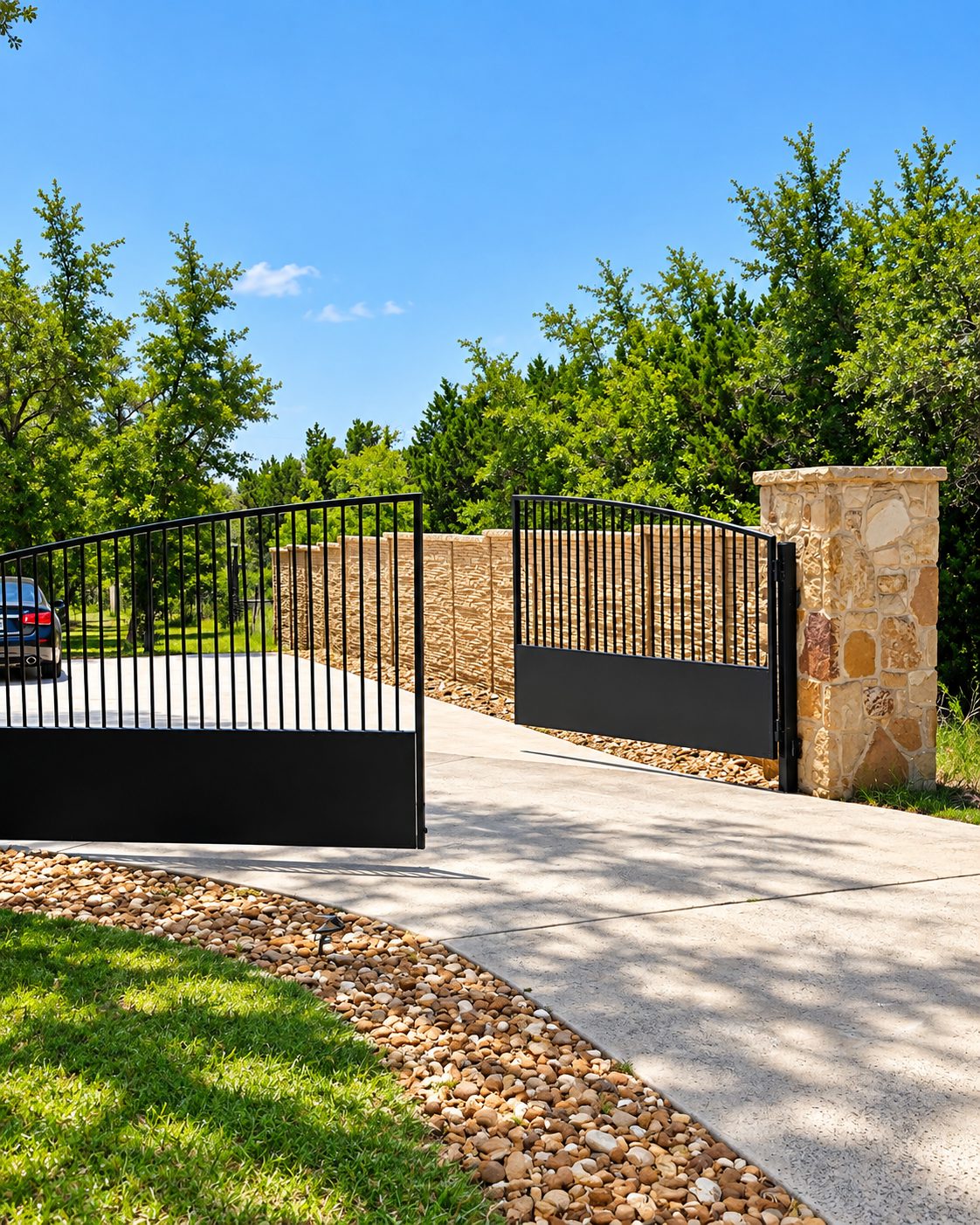
As our crew lead puts it: an automatic gate should operate properly as a gate before you ask a motor to move it. If the gate is dragging, binding, sagging, or putting too much resistance on the operator, replacing the operator alone doesn’t solve the real problem.
Gates rarely break all at once. They degrade, and the degradation hides inside a machine that keeps compensating until it can’t anymore.
Here is the sequence we find over and over. A hinge post shifts a fraction of an inch on the ground. The panel drops slightly out of level. From that moment on, the operator works harder on every cycle because the gate no longer swings freely. Nothing looks wrong. The gate still opens.
Months later, the operator starts hesitating, stopping short, or failing, and the owner concludes the machine is finished. It often is by then. But the machine was never the problem; it was the thing absorbing the problem.
This is why fitting a new operator to a gate that binds is the most expensive way not to solve anything. The new one inherits the same resistance and heads down the same road, usually within eighteen months. Repair that starts at the motor, not the panel, gets repeated.
Mechanical or electrical: telling them apart
You can usually narrow it down yourself in about a minute, without tools, just by listening to what the gate does when you trigger it.
It hums but does not move. The motor is running, and something is physically stopping the panel. That’s mechanical, every time. On a slide gate, it points at the track or the rollers, and a slide gate that’s come off its track behaves exactly this way. On a swing gate, it usually means the hinge post has moved, and the panel is dragging through part of its arc. On other companies’ installs, the repeated finding is hinge posts that were never substantial enough for the gate, and operators fitted to compensate for a gate that wasn’t moving freely in the first place.
It moves partway and stops. Usually a limit switch or encoder telling the operator it has reached the end of travel when it plainly hasn’t. That’s often a calibration fix rather than a parts job, and it doesn’t need new hardware.
It does nothing at all. That’s power. Either the operator itself, a dead backup battery, or, on a solar setup, a charging problem that’s been developing quietly for months. A gate that won’t open at all is the most common emergency call we take.
It opens but refuses to close. Almost always a safety device doing its job. A photo eye knocked out of alignment, a waterlogged loop detector, or a spider web across a sensor will all hold a gate open indefinitely. It’s the cheapest fix on the list, and the one owners least expect.
H2: What the weather does
Central Texas gives gates two seasonal problems, and both arrive on a schedule.
Cold snaps strain batteries and control boards. Capacity drops, marginal systems stop being marginal, and gates that were quietly under-powered all year pick February to prove it. That’s the pattern to watch for after a hard freeze.
Heat works differently. It cooks batteries on solar installations and accelerates wear on anything already running hot, which, on solar-powered systems, compounds with a gate that has gradually become harder to move.
Wind is the factor almost nobody accounts for, and it’s structural, not seasonal. A large solid panel catches a great deal of it, and every gust loads the panel, posts, hardware, and operator. Gates specified as a style choice rather than a structural one show it first.
Ground movement is the third seasonal factor and the slowest, and what sits under the posts decides how much it matters. East of the interstate, the soil is expansive and shifts with moisture, taking posts with it. That is the mechanism behind most of the alignment faults we see on that side of the metro.
What you can safely check
Some of this you can rule out before calling anybody, and it’s worth five minutes.
Look at the safety sensors first, because they’re responsible for more callouts than anything else on this list. Photo eyes should face each other squarely, with clean lenses and nothing in between them. Wipe them. Check the loop area in the drive for standing water. That alone resolves a fair share of the gates we’re called out to.
Then try the manual release, which is the single most useful test available to you. If the gate moves freely by hand, the panel is fine, and your fault lies in the machine or its power supply. If it drags, binds, or needs a shove, you’ve found your problem and no operator will fix it.
Look at the closed gate from the side. Is the panel level? Do the two halves meet evenly? A visible droop means the hinge post or the panel has moved, and that’s a foundation question rather than a hardware one.
Then check the obvious power items before assuming the worst. A tripped breaker, a disconnected battery lead, or a solar panel that’s now shaded by three years of growth nobody was watching. No technician needs to spot any of that.
What not to attempt
Everything past that point involves either mains voltage or a heavy panel under load, and neither is a reasonable place to experiment.
Control boards, capacitors, and wiring aren’t DIY territory on a machine wired into the supply. Manufacturers publish what the equipment requires; LiftMaster’s operator installation documentation is a reasonable place to find it. Neither is anything involving a gate panel that someone has to hold, lift, or lever while somebody works underneath it. We don’t publish step-by-step instructions for those jobs because the failure mode isn’t a broken gate.
If a job needs a new circuit or panel work, we bring in a licensed electrician rather than improvising.
When it needs a visit
Some faults need someone on the driveway. If the gate doesn’t move freely by hand, if the panel sits visibly out of level, if the operator has already had a board or a gearbox, or if the fault comes and goes with the weather, you’re past what a phone call can settle.
Diagnosis is genuinely investigative work. The symptom and the cause are often different things, which is why we cycle a gate and watch it before opening anything up. Regular servicing prevents a decent share of these calls. When a unit is genuinely finished, operator replacement is specified for the panel it has to move, not what was there before.
On busy commercial entrances, the same faults arrive faster because a gate cycling fifty times a day reaches the end of any degradation curve sooner than a household gate.
What it costs to guess wrong

We labor the mechanical-first point because guessing wrong is expensive in a specific, repeatable way.
Say a gate starts hesitating. The obvious move is a new operator, and plenty of companies will sell you one without asking why the old one struggled. It goes in, the gate works, everybody’s satisfied. Eighteen months later, the new unit is doing exactly what the old one did, because the hinge post that shifted two years ago is still where it shifted to.
Now you’ve paid for two operators and still have the original fault. Worse, the second failure usually comes with less warning than the first, because the replacement fought resistance from the day it was fitted rather than developing into it gradually.
The alternative costs less and sounds like less. Reset the post, bring the panel back to level, and the original operator often has years left. That’s a smaller invoice and a harder sell, which is roughly why it doesn’t get offered as often as it should.
The pattern on busier gates
Everything above happens faster when a gate cycles more, and the difference is larger than owners expect.
A household gate opens perhaps six times a day. An apartment entrance opens sixty times. That’s ten times the wear on chain, rollers, hinges, and the operator, so a degradation curve that takes four years on a house runs its course in months on a busy site. It also means early warning signs get less attention, because nobody owns a commercial gate the way someone owns the one on their driveway.
The practical consequence is that scheduled servicing pays for itself on a busy entrance and rarely does on a quiet one. Wear becomes predictable when a gate moves constantly, making it worth inspecting on a calendar rather than waiting for a call.
The shape of the answer
Almost every automatic gate failure comes down to one of four things: the panel isn’t moving freely, a limit is set wrong, the power isn’t arriving, or a safety device is holding the gate open.
Work through them in that order, and you’ll identify most faults before anybody opens a cover. Work through them backward, which is what replacing the operator first amounts to, and you’ll often pay twice for the privilege.
Ace Automated Gates | Austin works out of 1821 Heatherglen Ln, Austin, TX 78758. We’ve been repairing gates here since 2013; we’re fully insured, and we back our work with a one-year craftsmanship warranty. Our service list covers the full range, and the cost section explains the variables.
It’s worth remembering throughout that the gate itself matters more to all of this than the hardware bolted to it, and that on a house the same timeline simply runs longer. Call (512) 236-5178 and tell us what the gate is doing.