
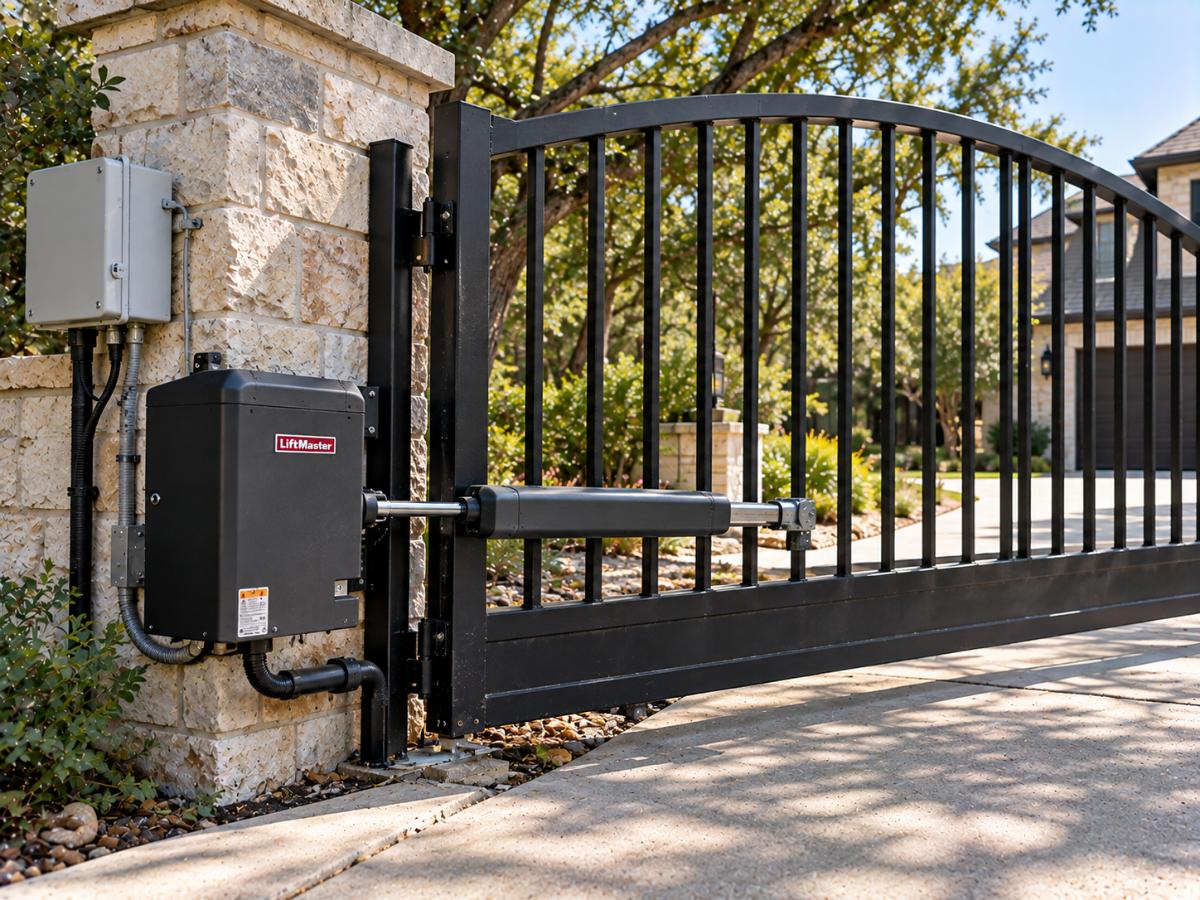
An automatic gate earns its money on properties where somebody would otherwise get out of the car, and loses it on properties where the gate barely moves. That’s most of the answer, and it’s worth being honest about which one you have.
If you want a view on your own entrance, tell us how the gate gets used or call (512) 236-5178.
What you’re actually buying

Three things, in roughly this order of importance.
Not getting out of the car. It sounds minor until you add it up. A household coming and going four times a day in Texas summer heat, or a February norther, opening and closing a gate eight times. Over a year, that’s thousands of trips, and it’s the reason most owners who automate say they’d do it again.
A gate that’s actually closed. A manual gate on a busy household tends to end up propped open, because closing it every time is a nuisance. An automatic gate closes behind you whether you remember or not, which is the difference between having a gate and having a gatepost.
Control over who comes in. Once a gate is powered, you can control who comes through: codes for the cleaner, an intercom for deliveries, credentials you can withdraw. None of that exists on a manual gate.
Resale value gets mentioned a lot, and we’d put little weight on it. Buyers notice a gate; it’s harder to claim it moves the price, and we won’t pretend otherwise.
When it’s clearly worth it
Some properties make the decision easy.
Long drives and acreage. When the gate is a few hundred feet from the house, manual operation means a round trip on foot or a vehicle stop in both directions. Automation changes daily life most on rural property.
Heavy gates. Moving a large steel or iron panel by hand is hard, especially on a slope or in the wind, and a rolling panel is even harder without power. Automation isn’t a convenience there so much as the thing that makes the gate usable.
Entrances with real traffic. Any site where visitors, deliveries, or multiple households come through needs a way to let people in without somebody walking down. At a busy commercial entrance, it isn’t a judgment call.
Security that needs to be real. A gate that’s genuinely shut, with credentials you can revoke, is a different proposition from a barrier that’s open half the time.
When it isn’t
We’d rather say so on the driveway than take the work.
A gate you rarely use. If you open the entrance twice a week, the convenience argument mostly disappears. You’re buying equipment that will need servicing to solve a problem you encounter rarely.
A gate that doesn’t move freely now. Automation makes a bad gate worse, not better. If the panel drags, binds, or sags, an operator will fight that on every cycle and fail early. The gate has to be sound first, and sometimes replacing it is the cheaper route.
Posts that were never built for it. Automation loads a hinge post in ways hand-opening never did. Where the posts are undersized, automating means rebuilding the foundation too, which changes the arithmetic.
No practical power. It’s solvable with solar, but on a short drive where mains is awkward, and usage is light, the cost of solving it can outweigh the benefit.
What it commits you to
This is the part worth knowing before rather than after.
An automatic gate is an outdoor machine that moves under load, so it needs occasional attention. Not much: clean sensors, a clear track, and a look at how it’s moving. If you have one, a call box needs the same occasional check. Routine care takes a few minutes a month and prevents most of the calls we get.
It also means a professional visit when something goes wrong, because the parts that fail aren’t owner-serviceable. You also need power at the entrance, and a plan for outages.
None of that is onerous. But a manual gate asks nothing of you, and an automatic one asks a little. Knowing that beforehand is the difference between a system you’re glad you fitted and one you resent.
Automating a gate you already have

Where the existing gate and posts are sound, adding an operator is usually cheaper than a new build and keeps the entrance’s look.
The questions are whether the panel moves freely by hand, whether the hinge post can take the extra load, and whether the configuration you have suits an operator at all.
How operators move a gate explains what the machine needs from the gate, and what a build involves covers the alternative if the answer is no.
Where the answer is yes on all three, automation is usually the easy call. Where the answer is no on any one of them, the honest comparison stops being automation against manual. It’s automation plus repairs against a gate that was built for it from the start.
Ace Automated Gates | Austin works out of 1821 Heatherglen Ln, Austin, TX 78758. We’ve been building and automating gates here since 2013; we’re fully insured, and we back our work with a one-year craftsmanship warranty. We’ll tell you when it isn’t worth doing. Call (512) 236-5178.