

A gate opener not working comes down to four things: no power reaching it, a safety device holding it, a limit set wrong, or a panel gone too hard to move. Telling them apart takes a few minutes.
If you need it dealt with now, call us on (512) 236-5178. A gate stuck shut is an access problem; a gate stuck open is a security one, and we schedule those differently.
Start by listening

What the gate does when you trigger it narrows the cause faster than anything else.
Nothing at all: no sound, no light. That points to power. Either the supply is interrupted, a battery has gone flat, or, in a solar setup, the system has quietly stopped charging.
It hums or clicks but doesn’t move. The machine is trying, and something is stopping the panel. That’s mechanical, and no amount of electrical work will fix it.
It starts, then stops or reverses. Usually a safety device doing its job, or a limit telling the operator it’s reached the end of travel when it hasn’t.
It opens partway every time. A limit or obstruction at the same point in the travel; on a sliding gate, that usually means the track. A fault that turns up at the same position every time is mechanical.
As our crew lead puts it: an automatic gate should operate properly as a gate before you ask a motor to move it. If the gate drags, binds, sags, or puts too much resistance on the operator, replacing the operator alone won’t fix the real problem.
What you can safely check
Four things, none of which involve opening anything or touching wiring.
The safety sensors. The two small devices facing each other across the opening stop the gate from closing on a vehicle, and a misaligned or dirty one can hold the gate open or prevent it from moving. Wipe the lenses and check that nothing has grown or been placed between them. This resolves a meaningful share of the gates we are called to.
Standing water over the loop detector. Vehicle sensing sits in the drive and suffers for it. Where a vehicle-sensing loop is cut into the drive, water sitting over it can confuse the system. That’s not something to fix yourself, but it’s useful to mention when you call.
The obvious power items. A tripped breaker at the house. On a solar system, whether growth has shaded the panel since last year.
The manual release. Every operator has one, and it disengages the drive so you can move the gate by hand. It’s also the single most useful test available to you.
H2: The manual release test
With the operator disengaged, push the gate by hand through its full travel.
If it moves freely, the panel is sound, and your problem is in the machine or its power supply. That’s a technician’s job, but it’s the easier of the two.
If it drags, binds, or needs a shove at any point, you’ve found the real fault. The gate’s become hard to move, and the operator has been fighting that on every cycle, probably for months. Fitting a new operator would just reset the clock. The way a gate degrades follows that sequence from the start.
Either way, knowing which answer you got makes the phone call far more useful.
What not to attempt
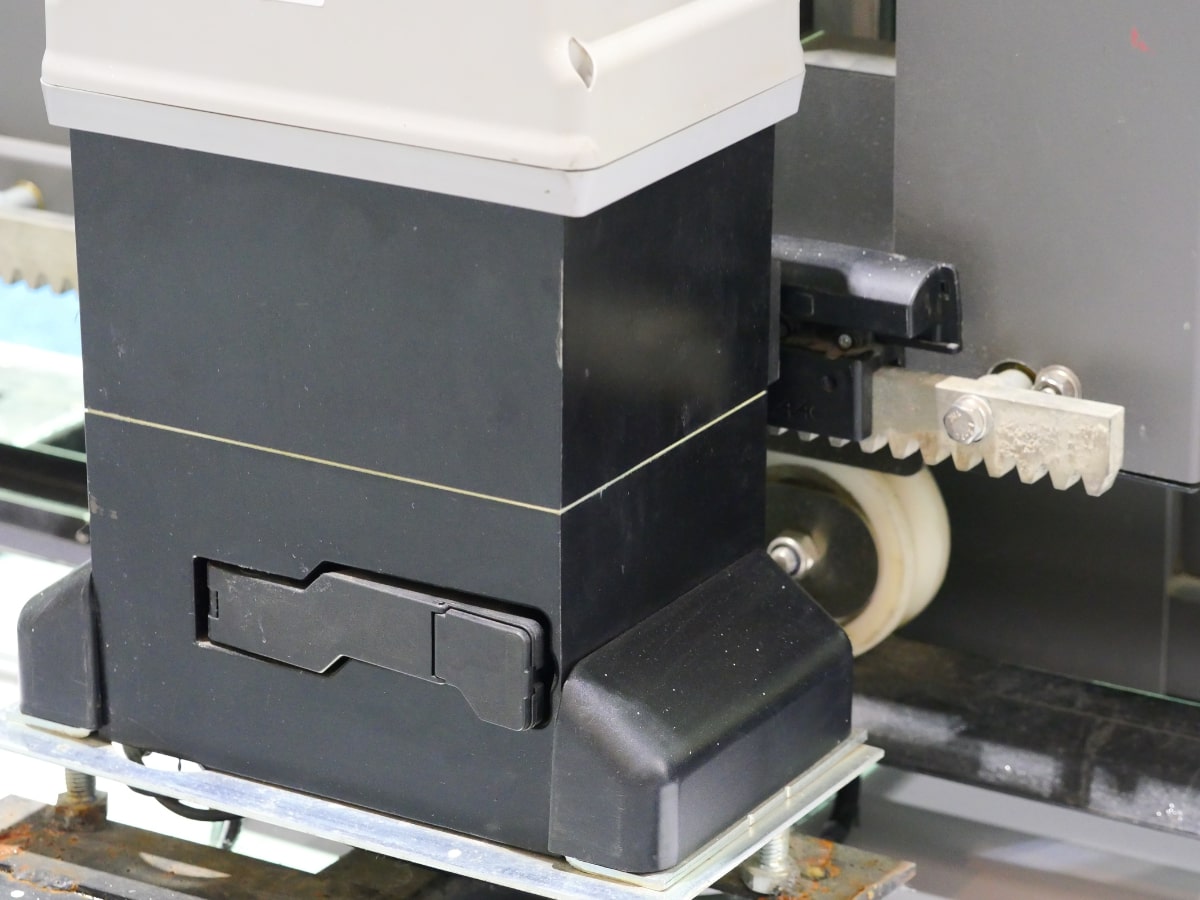
Everything past the manual release involves mains voltage, a heavy panel under load, or both.
Control boards, capacitors, transformers, and wiring aren’t owner-serviceable on a machine connected to the supply, and the failure mode isn’t a broken gate. Neither is anything that requires a panel to be held, lifted, or levered while someone works beneath it. A driveway gate weighs enough to cause serious injury if it moves unexpectedly.
Manufacturers publish operator specifications and installation procedures; LiftMaster’s slide gate operator documentation sets out what the equipment requires. Reading it is useful. Working on a live board because of it isn’t.
If a job needs a new circuit or panel work, we bring in a licensed electrician rather than improvising.
What we do when we arrive
We cycle the gate and watch it before opening anything, because the symptom and the cause are frequently different.
Then the mechanical side first: hinges, posts, track, rollers, chain tension. Then the operator, its board, and its power. Then the accessories, including the entry devices if the gate isn’t responding to a keypad or remote. We carry the parts that fail most often on properties around here, so we often finish these on the first visit. A repair visit covers the full range.
On other companies’ installs, we often find hinge posts that were never substantial enough for the gate, and operators fitted to compensate for a gate that wasn’t moving freely in the first place.
If the operator itself is finished
Sometimes it is, and we’ll say so rather than sell a repair that won’t hold.
Once a unit has had both a control board and a gearbox replaced, you’re paying twice for a machine heading toward the same failure. At that point, replacing the operator against the panel it has to move is the honest answer, and if the gate itself has reached the end, a full replacement is a different conversation.
What we won’t do is fit a larger operator to force a gate that binds, whatever type of gate it is. That works for a while and fails the same way.
Ace Automated Gates | Austin works out of 1821 Heatherglen Ln, Austin, TX 78758. We’ve been repairing gates here since 2013; we’re fully insured, and our work comes with a one-year craftsmanship warranty. Monthly checks prevent many of these calls. Call (512) 236-5178 and tell us what the gate is doing.